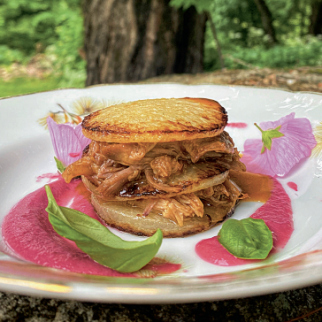
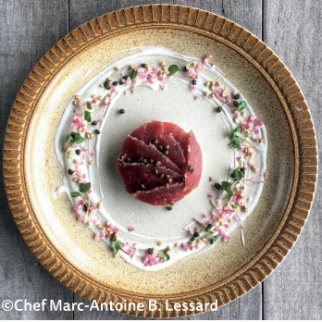
I first heard of chaga around 2014, from the business Chapeau des bois which delivered it to the restaurant where I was working in Quebec City. My first contact with this rough, black fungus was through a decoction (infusion). I next had the pleasure of rediscovering it in a beer created on a chaga base. Since then, an increasing number of Quebec chefs have started to incoroporate it into their recipes. My first dessert that incuded chaga was a maple crème brulée. It was much enjoyed by those tasting it, and I still remember their expressions when they learned the provenance of this intriguing ingredient.
Only a few years later, after having read some informative material, I went to harvest my first chaga… which was enthroned on the bark of a living yellow birch. The wild harvesting of this bracket fungus usually takes place in winter on both white and yellow birch. Deep cold brings the highest level of certain therapeutic molecules. However, summer harvesting allows the fungus to regrow more quickly and to heal before winter.
By climbing up an old trunk beside a birch, I was able to detach the chancre of chaga from the birch, being careful to leave part of the fungus in its fissure. Back at the house, I cut it into big pieces, after which I worked them to a texture like gold nuggets. Once they were well dried, I was able to keep them for my recipes and decoctions.
I love reading stories and legends and this fungus, which is considered to be a superfood, has piqued my curiosity for years. Chaga has been used as a medication for millennia and there are a number of works to read on this subject.
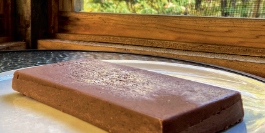 For those with a sweet tooth, I often make a honey-choocolate caramel scented with chaga to accompany some of my desserts.
Chaga on the menu: a good resolution for the new year.